
LEARN MORE
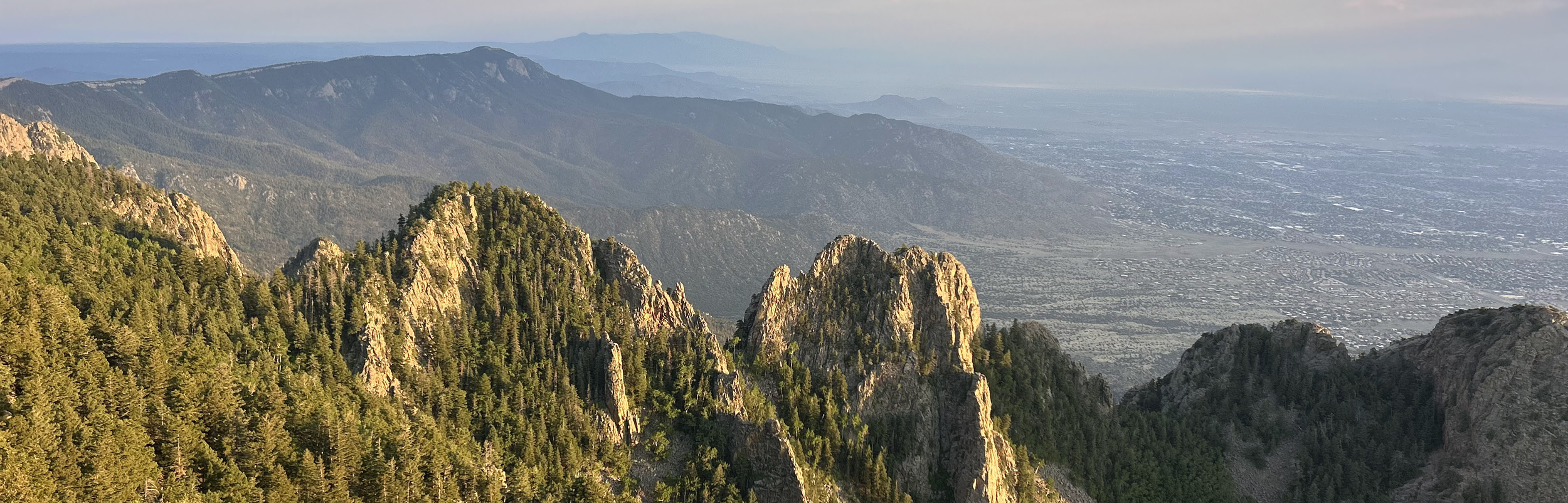
The proposed transfer encompasses roughly 10,000 acres of the Sandia Mountains
What is the issue?
The Pueblo of Sandia is asking Congresswoman Melanie Stansbury to propose legislation that would transfer nearly 10,000 acres of public land on the west side of the Sandia Mountains to the Pueblo of Sandia, making the land part of the Sandia Reservation.
Here’s what is being proposed, what protections exist today and why many New Mexicans believe there is a better path forward.
What is being proposed?
The Pueblo of Sandia is seeking federal legislation that would transfer nearly 10,000 acres of public land on the west face of the Sandia Mountains away from the U.S. Forest Service to the Department of the Interior, where it would be moved into trust for the benefit of the Pueblo and become part of the Sandia Reservation.
What is the land boundary?
The proposed transfer includes land currently governed by the T’uf Shur Bien Preservation Trust Area and some of the mountain’s most heavily used public recreation areas, extending from the Sandia Peak Tram north through the La Luz and Piedra Lisa areas and north to Placitas.
What exists today?
The area is currently part of the Cibola National Forest and much of it has been a federally designated Sandia Mountain Wilderness since 1978.
In 2003, Congress passed the T’uf Shur Bien Preservation Trust Area Act to resolve a decades-long dispute over the eastern boundary of the Sandia Pueblo. The law protects three things equally. It recognizes and protects the Pueblo’s cultural and traditional interests while also giving the Pueblo a specific consultation role in how the area is managed, preserves the National Forest and Wilderness character of the land, and protects public access and recreation. The Act specifically states that these protections are “in perpetuity,” reflecting the clear intent of Congress and all parties to the agreement.
Who owns the land today?
The land is federal public land owned by the United States and managed by the U. Forest Service as part of the Cibola National Forest.
The ownership question was resolved in the 2003 settlement. Sandia Pueblo relinquished its ownership claims, and Congress permanently extinguished all Pueblo claims to right, title, and interest in the area, including aboriginal claims, while expressly confirming United States title. In exchange, the Act protected defined Pueblo cultural, traditional, and consultation interests alongside National Forest, Wilderness and public interests.
Despite the word “Trust” in its name, the T’uf Shur Bien Preservation Trust Area is not Indian trust land and is not owned by Sandia Pueblo. It remains federal public land.
The current proposal would fundamentally change everything. The land would be changed to held in trust for the benefit of Sandia Pueblo and would be subject to tribal jurisdiction rather than managed as National Forest as public land. The Pueblo’s proposal is not simply a change in management or administration. Instead, it would reverse a central element of the 2003 settlement by changing the ownership, jurisdiction and legal status of this 10,000 acres of land.
Why is a transfer being proposed?
Sandia Pueblo has raised concerns about management of the area, including litter, vandalism, impacts to culturally sensitive areas, road and trail conditions, overuse, and limited Forest Service staffing and enforcement. Those concerns deserve to be addressed. However, the central question is whether addressing those problems requires transferring ownership and control of nearly 10,000 acres of National Forest and Wilderness land out of public hands. To us, these are management issues, not ownership issues.
2003 Settlement
The 2003 agreement was specifically designed to balance the Pueblo’s rights and cultural interests, protection of the Sandia Mountain Wilderness, Forest Service management and continued public use of the area. It provides the Pueblo with protections and management participation, while also establishing processes for consultation and resolving disagreements with the U.S. Forest Service.
Rather than replacing that carefully negotiated framework, many New Mexicans believe the parties should use it, strengthen it where necessary and provide the resources needed to make it work. Management problems should be solved through better management, cooperation, and enforcement before Congress considers permanently changing the ownership and legal status of the land.
Senator Heinrich’s Statement
Senator Martin Heinrich has stated that he does not support transferring title away from the Forest Service or eliminating the area’s Wilderness protections. Instead, he is considering exploring legislation that would strengthen the Pueblo’s role in stewardship while preserving existing federal management, Wilderness protections and public access.
This approach recognizes an important principle: protecting Sandia Pueblo’s cultural connection to the mountains and protecting public land are not mutually exclusive.
Bernalillo & Sandoval County Positions
According to August 26 reporting, Bernalillo County Commissioner Walt Benson said the county currently has no plans to consider a measure supporting the transfer. Benson also stated: “I’m not in support of this transfer, and I want it to stay the same.” The same report says Sandoval County Commissioner Katherine Bruch acknowledged that commissioners had not seen the transfer language before their June 24 vote. She said their intention was to protect access—not endorse exclusive Pueblo ownership. Read reporting from City Desk ABQ
Sandoval County initially voted to support the Sandia transfer in June, however an article published on September 11 in the Rio Rancho Observer says the County is prepared to withdrawal that support. Sandoval County Manager Wayne Johnson called for Sandia Pueblo to be more clear about their proposal. He stated that it’s the county's understanding that the transfer is a management change, not an ownership change. Johnson said the county is prepared to rescind support for the transfer if it’s an ownership change. Read reporting from Rio Rancho Observer
Impacted Neighborhood Positions
The Tierra Monte, Evergreen Hills and Sandia Heights neighborhoods, totaling nearly 2,300 households, have come together to oppose the transfer of land in the Sandia Mountains and to reiterate that the 2003 Settlement Act settled the ownership claim between Sandia Pueblo and all parties. Read the neighborhood statements
Community Positions
The wider community is also calling for addressing concerns without transferring the land out of federal ownership.
Sandias For All’s Position
Sandias For All is a coalition working to protect public access to the Sandia Mountains. We support community stewardship of the mountain to strengthen management by the US Forest Service. Sandias For All is dedicated to protecting the integrity of the 2003 T'uf Shur Bien Preservation Trust Act, which was intended to stand in perpetuity. We are strongly opposed to any plan that changes ownership of this 10,000 acres and moves management away from the US Forest Service.
Additional Reading & Documents

Additional Maps Showing Trust Boundaries
(click for larger versions)


Sandias For All Petition
We started an online petition asking our NM Congressional Delegation to:
Protect and uphold the 2003 T’uf Shur Bien Preservation Trust Area Act and its permanent protections of public lands for all.
Keep the 10,000 acres within the Cibola National Forest and under the protection of the Sandia Mountain Wilderness.
Protect public access for all recreational uses, roads, easements and wilderness.
Start a task-force that brings the US Forest Service, the Pueblo of Sandia, local governments, neighboring landowners, conservation organizations, recreation groups, and other stakeholders together to address concerns and solutions using the existing framework provided by the 2003 agreement.
Why Are People Concerned?
People have raised a variety of concerns about the proposal, including:
Public Access & Dispersed Recreation
The Sandias support over 2 million hikers, climbers, backpackers, runners, birdwatchers, hunters, photographers and families each year. The Sandias are central to Albuquerque’s identity and public access fuels New Mexico’s outdoor recreation economy. Not all of this recreation happens on “maintained trails”, which is permitted under current USFS management.
Wilderness Protections
Wilderness designations are intended to provide permanent protection for America's most treasured public lands. Many people are concerned that transferring these lands out of U.S. Forest Service management could put those long-standing Wilderness protections at risk.
Setting a Precedent
Transferring federally protected Wilderness and National Forest lands could set a precedent for similar actions elsewhere.
Existing Agreements
The 2003 legislation was intended to permanently resolve the underlying boundary land claim dispute. It stated that “all Pueblo claims to … lands within the Area … are hereby permanently extinguished,” while protecting in perpetuity the Pueblo’s rights and interests, the public’s longstanding use and enjoyment of the area and the wilderness designation.
In The News
OPINION: New Mexicans shouldn't have to choose between respecting the pueblo and keeping Sandias
Pueblo’s Sandia Mountains land transfer plan faces new push back at Bernalillo County meeting
How Proposed Sandia Mountains Land Transfer May Affect Real Estate
Senator Heinrich working on bill to share Sandia Mountains management with Sandia Pueblo
New Mexico Wild Statement on Sandia Pueblo Transfer Act Proposal
Senator Heinrich Opposes Sandia Pueblo Push to Take Wilderness Land Into Reservation
New Mexico Climbers Resource and Advocacy Group & Access Fund Statement on Proposed Land Transfer
Letters To The Editor
FAQs
-
The T'uf Shur Bien Preservation Trust Area Act, passed by Congress in 2002, resolved decades of litigation over the Sandia Mountains.
The legislation was the result of years of negotiation among the Pueblo of Sandia, the United States, local governments, private property owners, recreation advocates, and other stakeholders.
Rather than transferring ownership of the land, Congress created a unique compromise that:
Recognized the Pueblo's historic and cultural connection to the Sandias.
Guaranteed permanent access for traditional and religious practices.
Preserved public lands under the U.S. Forest Service.
Protected designated Wilderness.
Ensured continued public recreation and access.
Protected homeowners and existing property rights.
Ended the underlying litigation.
The agreement was designed to balance the interests of everyone with a connection to the Sandia Mountains.
-
The Pueblo of Sandia argued that an 1859 federal survey incorrectly established the eastern boundary of its historic Spanish land grant.
In response, Congress approved a negotiated settlement that acknowledged the Pueblo's concerns while preserving federal management of the land.
Supporters described the legislation as a carefully crafted compromise that allowed everyone to give something and gain something. It was intended to provide a permanent resolution to the dispute.
-
The Pueblo is proposing legislation that would transfer approximately 10,000 acres currently managed by the U.S. Forest Service into trust for the Pueblo of Sandia.
Unlike the 2003 agreement, this proposal would move the land from the U.S. Forest Service to the Pueblo of Sandia, making the land a part of the Sandia Reservation. The two-page draft proposal leaves many questions unanswered. The new proposal would replace a carefully negotiated agreement that has successfully balanced competing interests for more than two decades.
-
Over two million people recreate throughout the Sandia Mountains annually, including on the 10,000 acres of the public T'uf Shur Bien Preservation Trust Area.
Pueblo leaders have stated they intend to maintain access to existing trails, roads, and utilities. They have not specified which trails count as “existing trails”, and public access to the entirety of the 10,000 acres and the trails is not mentioned in the draft legislation.
At the same time, they have acknowledged that future Pueblo governments could make different decisions about public access and have expressed interest in limiting off-trail travel.
While no one knows how the Pueblo would manage these lands (for example, close them entirely to the public, require guides for hikes, require appointments for hikes, charge high access fees, etc.) the recent changes at Tent Rocks could
offer an indication.Tent Rocks, which is co-managed by the BLM and the Pueblo of Cochiti, was closed for over four years during and after
COVID.Now Tent Rocks is:
• Closed about 8 weeks per year (including from December 15 to January 31)
• Requiring appointments to hike/visit:
• Requiring that “Visitors must obtain a Cochiti Pueblo Tribal Access Pass directly from the Pueblo prior to entering the
Monument,” which cost $20 per adult, $10 per child. -
The T'uf Shur Bien Act was the result of years of negotiation and compromise. It protected Pueblo cultural rights while guaranteeing public access, Wilderness protections, recreation, and private property rights.
That balance has worked well for more than two decades and all of the Pueblo’s stated concerns can be addressed through the 2003 framework.
-
The proposal includes thousands of acres of federally designated Wilderness.
It is unclear how existing Wilderness protections would be preserved if these lands are transferred out of U.S. Forest Service management and into trust.
-
The Pueblo has said that the USFS budget has been cut and that this justifies transferring the 10,000 acres.
The data shows robust growth:
Year-by-Year Total Budget Enacted (FY 2017 – FY 2026)
The figures below represent total regular agency appropriations (discretionary and mandatory combined) based on historical USDA Budget Summaries and congressional disclosures: [1, 2, 3, 4, 5]
FY 2017: $5.67 billion
FY 2018: $4.73 billion (Reflected structural cuts to non-fire programs)
FY 2019: $5.95 billion
FY 2020: $5.14 billion
FY 2021: $7.42 billion (Began receiving emergency infrastructure boosts)
FY 2022: $8.41 billion (Boosted significantly by the Bipartisan Infrastructure Law)
FY 2023: $9.30 billion
FY 2024: $9.50 billion
FY 2025: $8.90 billion (Enacted under temporary Continuing Resolutions)
FY 2026: $8.50 billion (Approved by Congress, rejecting steeper executive cut requests
-
Existing private property—including three residential subdivisions and several other privately owned parcels—would remain privately owned under the proposed legislation.
However, because many of these properties rely on access through the proposed land transfer area, there are concerns about long-term access, emergency services, law enforcement, road maintenance, etc. and how these services would be managed in the future.
Residents wonder if they will face similar access issues as those seen on Bernalillo County Road 36 of Forest Road 289, if their properties are surrounded by tribal land.
These issues were major considerations during the negotiations that led to the 2003 T'uf Shur Bien Act.
-
The most important thing is contact your members of Congress and ask them to preserve the balance established by the 2003 agreement
Share information with friends and neighbors
Sign our online petiton
Sign up for our email list to get updates on community outreach efforts, attending public meetings, and signing up for campaign updates
Supporting Documents
-
-
-
-
-
Tribes, residents find a solution in the Sandias, High Country News (2003)
Sandia Pueblo agreed to drop decades-old claim of ownership, ICT (2002)
Sandia Pueblo said poll it commissioned shows strong support for settlement, ICT (2001)
With a Mountain at Stake, Tiny Tribe and New Mexico Neighbors Do Battle, New York Times (1998)
New Mexico Pueblo Fights to Keep Its Ancestral Prize, Los Angeles Times 1997
The Tierra Monte neighborhood website provides an overview of the original dispute and negotiations leading to the 2003 Act, along with news clippings from 1998-2003. On the the Tierra Monte website, click “History” and then “Pueblo Claims” to read the articles.